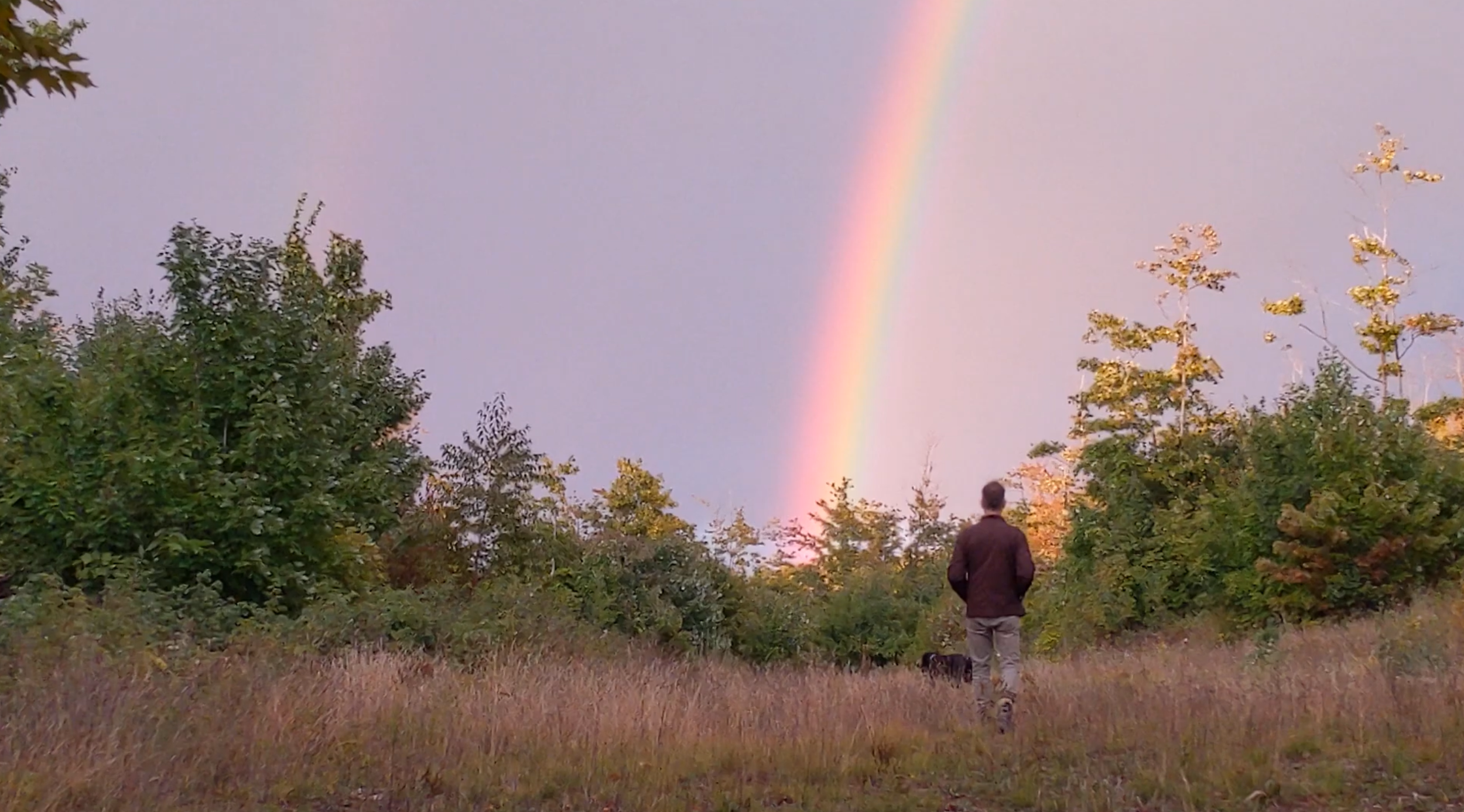
Photo by Todd Hoskins
Episode 36: Landscapes of Being—Wayfinding
Wayfinding once meant discovering one's path through never-before-encountered territory, step by experiential step — the opposite of its modern meaning, which is following signs through spaces already fully mapped. This inversion becomes the episode's animating question: what have we lost when we stopped reading the intelligence of living territories and started looking for the right playbook?
The conversation moves through Wade Davis's writings on dead reckoning, the Polynesian navigators who learned the speech of the Pacific through wave color and wind, and Andean farmers who read astronomical conjunction to time their planting. These examples ground a larger exploration of wayfinding as dialogue — the same capacity applies to how a new CEO might listen to the living speech of an organization rather than adjusting its rule book. The episode concludes with both hosts reflecting on what it means to find our way rather than the way: an orientation toward living in connection.
Todd's Potentialities essay "At the Threshold" extends this into the territory of risk, tracing two forgotten etymologies — the reef navigators had to track and the gift of providence that comes through genuine exchange — and finding in the figure of Hermes a guide who moves with uncertainty rather than eliminating it. For leaders caught between recklessness and paralysis, this episode offers a more fundamental shift: restoring connection with the territory itself brings us all toward home.
Series: LANDSCAPES
In a time when many feel unmoored from both the natural world and their own sense of purpose, the Landscapes series offers essential navigation tools for finding your way. As global upheaval reshapes everything we thought we knew, the wisdom of belonging to place becomes vital for thriving.
This series challenges the Western illusion of separation that leaves us exhausted, anxious, and ineffective. Whether you're leading an organization through uncertainty, seeking personal direction, or simply trying to make sense of chaotic times, understanding how landscapes both external and internal shape consciousness provides pathways forward. We'll explore how becoming skillful wayfinders—learning to read the territories we're crossing and work with larger forces of change—can restore capacity to create abundance and evolve into states of thriving when traditional approaches have failed.

Photo by Pia Kealey
Timeline
00:45 Marti’s introduction
02:24 Meaning of wayfinding — how modern usage inverted the original meaning
04:25 Lewis and Clark, Polynesian navigators, Vikings
04:53 Wade Davis on dead reckoning
05:21 Have we lost our capacity to dialogue with the landscapes of our lives?
05:58 Evidence of disconnection: isolation, uncertainty, not knowing where we belong
06:50 Wayfinding is in our souls — we were born to absorb geographies
07:45 The purpose of wayfinding: finding our place in the landscape of life 0
8:14 Human-to-spirit dialogue keeps us from behaving as though we own the planet
12:06 Wayfinding ignited the seeds of human culture through diversity
12:59 Wayfinding can bring us home
13:53 Home as the place where our power can manifest and we are connected
14:18 Marti: complementarity in full consciousness — walking into the unknown brings us home
15:27 Todd: "dia-logos" — speech across; what does dialogue with the non-human world actually mean?
16:14 Marti: examples of listening to the speech of the land
16:29 Indigenous farmers in the Andes, nomadic hunters in the Arctic, Native American fishing cultures
18:24 What we've lost: forest fires, plastic, and the molecular speech of organic elements
19:20 The Mayan teaching: the nature of a thing is its speech
19:42 Polynesian navigators and the speech of the ocean
22:09 Todd: the organizational landscape — a new CEO steps into a living culture
23:01 The default tendency: looking for the right playbook is like reading signs
25:06 Consciousness doesn't operate on “why”
27:22 Every organization is a landscape; the language is in the relationships
30:41 Marti: the constant Western pressure to stay in two-dimensional consciousness
31:39 The dimensional flatland — pressure and repetition instead of felt experience
32:05 What if organizations had a place to exercise the senses?
33:19 The territory wayfinders need to enter: experiential intelligence
33:53 Blindfolded and left in the woods at 18
37:08 It is in our nature to find the spot where we can set down roots
37:32 Todd: "Are you my mother?" — is this my land, my people, my purpose?
38:19 Identity as that from which you came; the deeper meaning of dead reckoning
40:55 Belonging to the land where you were born and the land where you live
42:28 Potentialities: "At the Threshold" (Todd)
57:04 Takeaways
Quotes
"Wayfinding originally took us far and wide, but now my sense is it can bring us home." — Marti Spiegelman
"The truth about humans is that wayfinding is in our souls. We were able to find our way across continents by listening to the land we walked." — Marti Spiegelman
"Wayfinding is a dialogue, and it's also the human faculty for engaging in dialogue with the essential speech of the land and seas and stars and elemental forces of nature." — Marti Spiegelman
"The nature of a thing is its speech." — Marti Spiegelman, citing the Mayan teaching
"Walking into the unknown is what brings us home. It's not one or the other. It's both at the same time." — Marti Spiegelman
"It's not finding the way. It's finding our way." — Todd Hoskins
"That deep sense of this is why I'm here, connected to the people who have come before me and stand beside me." — Todd Hoskins
"The discovery of both our genius and our belonging — that is the modern wayfinder's journey." — Marti Spiegelman
"Your total identity is a combination of your genius — whatever gift you have, claiming that — and the land that you belong to. Nature and earth within you, woven together." — Marti Spiegelman, citing the Dagara tradition
"Every organization is a landscape unto itself. The speech of a company is found in its living, breathing, experiential relationships." — Marti Spiegelman
"A lot of people live that way. They don't know the coordinates of where they are right now. And how terrifying that must be." — Todd Hoskins
"The depth of your love is the measure of your vulnerability." — Todd Hoskins
"The paralyzed person thinks they're avoiding risk by holding back their love, by keeping their commitments conditional, by staying defended. But they're not avoiding risk. They're avoiding life itself." — Todd Hoskins
"Hermes wasn't the god who eliminated risk. He was the god who moved with it." — Todd Hoskins
"The Greeks also knew Hermes as the god of windfall — the fruit that has already fallen from the tree. What comes to you not through your plans, but through your presence." — Todd Hoskins
"When you're in relationship with the world, you're being changed by it. The path you're on creates you as you create the path." — Todd Hoskins
"What we actually need are people who can restore their connection with the world — who can feel what's happening, track what's real, and respond with their whole being awake to what might happen." — Todd Hoskins
"Risk is inseparable from love. And risk is inseparable from life." — Marti Spiegelman
Links
The Wayfinders (Wade Davis book)
Martín Prechtel discusses the Tzʼutujil concept of "nature of a thing" on Green Dreamer podcast
Credits
Theme music courtesy of Cloud Cult