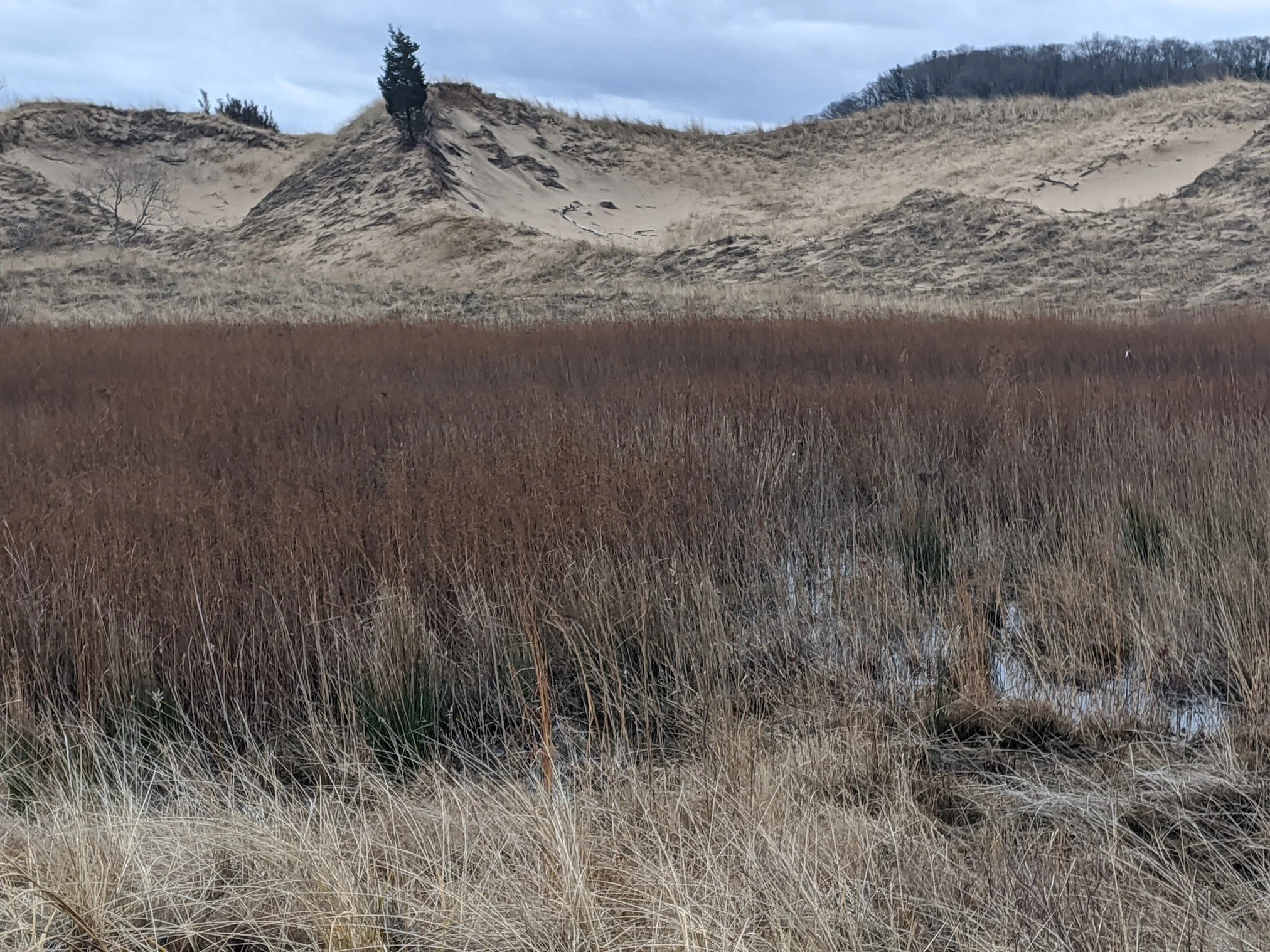
Interdunal wetlands photo by Todd Hoskins
Episode 37: Landscapes of Being—Ecotones
In the fourth episode of their Landscapes series, Marti and Todd explore ecotones — the zones in nature where different environments meet and interact, generating new forms of life that neither could produce alone. Todd opens with the etymology of ecotone — eco from the Greek for household, the living relationships of a place, and tone from the Greek for tension and stretching, the same root that gives us the vibration of a musical string and the vitality of a tonic. From the edge effect in ecology to the mangrove's capacity to generate what neither land nor sea could produce alone, Todd and Marti explore how biodiversity concentrates at edges and what that suggests about creativity, consciousness, and connection.
The conversation moves from ecology to the ecotones within ourselves and between us. Marti introduces the indigenous understanding of border work — tending the edges so exchange can happen — and the Andean principle of complementarities, where different things come together to create something new that benefits everything. Todd challenges the geographic bias of center and edge, suggesting that sometimes the edge is the center, and that creativity lives in the stretching between what we know and what is arriving. Together they explore ecotones as a model for organizational partnerships, healing through participation, and the human capacity to steward the creation of the never-before-imagined.
In Marti's Potentialities essay, "Infinite Arrivals," she reflects on how potentialities are not far away but always in motion toward us — and that the empty, spacious moments we often resist are themselves carrying vital information. Drawing on graphic design's principle of white space, she invites listeners to consider that they may be the very conduit for the next infinite arrival the world needs.
Series: LANDSCAPES
In a time when many feel unmoored from both the natural world and their own sense of purpose, the Landscapes series offers essential navigation tools for finding your way. As global upheaval reshapes everything we thought we knew, the wisdom of belonging to place becomes vital for thriving.
This series challenges the Western illusion of separation that leaves us exhausted, anxious, and ineffective. Whether you're leading an organization through uncertainty, seeking personal direction, or simply trying to make sense of chaotic times, understanding how landscapes both external and internal shape consciousness provides pathways forward. We'll explore how becoming skillful wayfinders—learning to read the territories we're crossing and work with larger forces of change—can restore capacity to create abundance and evolve into states of thriving when traditional approaches have failed.

Photo by Pia Kealey
Timeline
01:06 Todd's introduction: the Landscapes series arc — speech of the land, wildness, wayfinding
02:03 The participatory relationship between humans and the living world
02:22 Etymology of ecotone: eco (household) and tone (tension, stretching)
02:50 The musical string — tone is what emerges from stretching
03:09 Tonic as home note; home as a felt quality arising from the interactions of the whole
03:36 Tonic beyond music — something that restores vitality
04:00 Ecotone as the living relationships of a place stretched into interaction
04:27 The edge effect: biodiversity concentrates where different environments interact
05:21 The mangrove — an interaction so rich it becomes its own living world 05:44 The estuary, the alpine treeline, the hedgerow
06:10 Todd's story: a rave in a state forest in the mid-nineties
07:23 The forest was part of it — the interaction itself had come alive
08:05 Resisting polarity thinking — the interaction itself, not two sides
09:09 The etymology of resolve: from loosening to deciding
09:36 The etymology of belief: from holding dear to mental conviction
10:29 What if the tonic is in the interactions themselves?
10:54 Marti responds: the indigenous concept of border work
11:17 Borders need tending; the understanding that you work the borders so exchange can happen
11:40 Yanantin — the principle of bringing complementarities together
12:25 How consciousness keeps itself going by adding to the wisdom of the world
13:08 We need to do this with cultures, neighborhoods, and approaches to the sacred
13:54 Todd: border work and permeable membranes — containment with exchange
14:44 Marti: channels within cell walls; every exchange supports the growing and evolving of life
15:19 We're setting ourselves up psychologically to not understand ecotones
15:39 Todd: stretching as the culture sees it — stretch goals, exertion of will
16:17 Life stretches us; the string needs form but also needs to shift form
17:08 Marti: canopy gaps — when light strikes the forest floor, new life appears
18:16 In the Andes, this world is what light strikes
18:38 Angeles Arrien: your arms and hands are part of your heart; reaching is the heart's work
19:25 The wavelength of life — stretching and releasing as our basic rhythm
19:54 Todd: complementarities and the encounter of difference
20:11 The modern Western drive for sameness and why art is a revolt against it
20:27 Music, AI-generated music, and the difference between sameness and aliveness
22:49 Marti: encountering the never-before-seen is consciousness evolving
23:27 Nature moves forward into gaps — life says so, consciousness says so
24:40 The human capacity for music and tone; language so we can share our dreams
25:53 Everything we've been given is for expression and creativity
26:12 The ecotone within us; the Andean principle of replication vs. duplication
27:06 Essence is what gets replicated — knowing your uniqueness means you don't get lost in the joining
28:20 Reaching out is in our nature — wayfinding, connecting, expressing
29:16 Marti: how the meaning of words gets flipped — myth, resolve, belief
30:24 We need to become masters of the ecotone again
30:38 Todd: ecotones as a model for organizational partnerships
31:02 Organizations structured as walls around territory
31:34 Partnerships that create something outside industry, comfort zone, and expectations
32:55 The challenge: identity and authority make people hesitant to join
33:41 Todd: participation as healing
34:27 Marti: in Andean traditions, the healed state depends on connectivity
35:43 Todd: explore the ecotones within ourselves
35:54 Marti: we are conduits — our job is to steward creativity
36:49 Water as the example: the right proportion of complementarities creates the basis of life 37:19 We could be stewards of ecotone work, of border work
37:53 Todd: the geographic bias of center and edge — sometimes the edge is the center
39:03 The ecotone within: a library not of knowledge but of options, possibilities, and capacities
40:05 Marti: creative impulses as ecotone work — your new thing is an ecotone
41:12 Creating an ecotone between the parts of yourself you don't like and the parts you do
42:31 Potentialities: "Infinite Arrivals" (Marti)
57:50 Takeaways
Quotes
"This relationship between a human being and the living world is participatory. We are in the landscape. The landscape is in us. And what emerges from that participation is something that neither we nor the land could create in isolation." — Todd Hoskins
"Tone is what emerges from stretching." — Todd Hoskins
"Home is a felt quality that arises from the interactions of the whole." — Todd Hoskins
"The mangrove is an interaction so rich and sustained that it becomes its own living world." — Todd Hoskins
"A quality of aliveness was being generated that none of the ingredients could have produced on their own. The interaction itself had come alive." — Todd Hoskins
"What if resolving didn't mean ending tension, but rather a phase of loosening in order to stretch again? What if the stretching is where the music is?" — Todd Hoskins
"What if the tonic is not an idea, substance, place, or person, but the interactions themselves?" — Todd Hoskins
"The indigenous understanding is you work the borders so there is exchange." — Marti Spiegelman
"Life does stretch us. We stretch with life, and we contract, and then we stretch again." — Todd Hoskins
"They say in the Andes that this world that we live in is what light strikes." — Marti Spiegelman
"When you reach for what you want, you're reaching with your heart." — Marti Spiegelman, citing Angeles Arrien
"We have language so we can share our dreams." — Marti Spiegelman, citing Andean teaching
"If you know you're unique, you will move out in the world knowing your essence is never lost, and you will create with other people knowing your essence is additive." — Marti Spiegelman
"We need to become the masters of the ecotone again. We need to reach out to the other and see what happens. We need to walk into the unknown and have some fun." — Marti Spiegelman
"It is in the invitation to participation that healing begins." — Todd Hoskins
"We could be stewards of this ecotone work, stewards of this border work, and I really do think that's part of our job." — Marti Spiegelman
"My ecotone is not about reaching for the knowledge that I forgot. It's about reaching for or stretching to the knowing and the capacity that are together there." — Todd Hoskins
"Nothing is always something. And that kind of something is always really valuable." — Marti Spiegelman
"Intelligence exists in spaciousness. And any degree of pushing or efforting closes down that space." — Marti Spiegelman
"Falling might very well be flying without the tyranny of coordinates." — Bayo Akomolafe
"Perhaps you are the very conduit for the next infinite arrival the world needs now." — Marti Spiegelman
"An ecotone is a region of massive new resonances." — Marti Spiegelman
Links
Yanantin (Andean principle of complementarities)
Credits
Theme music courtesy of Cloud Cult